
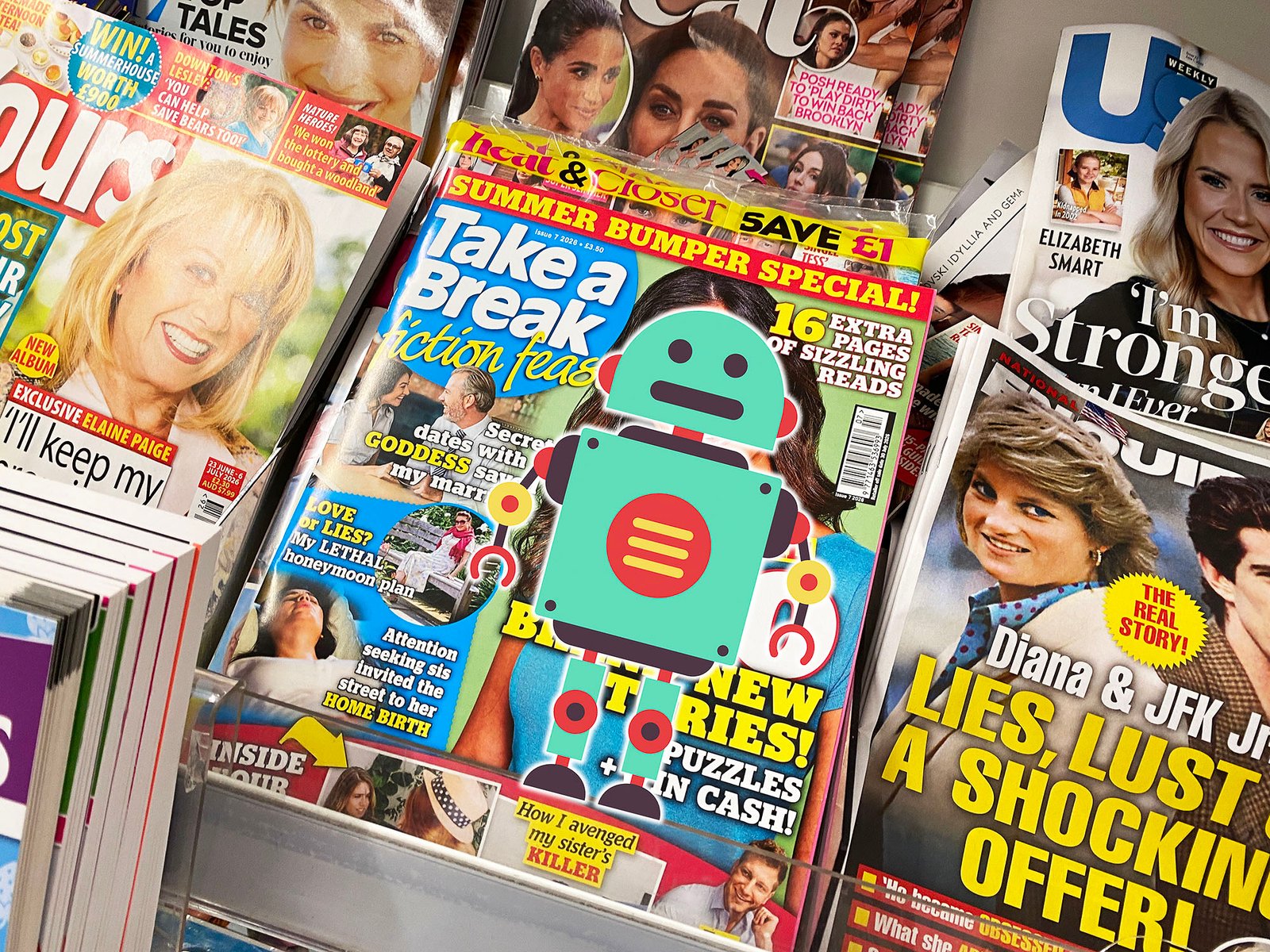
Is This the Death Knell for Magazine Short Story Writing?: Inside the Take a Break AI Scandal
With a major magazine pivoting to AI-generated short stories, does this mark a new, darker chapter in the world of human creativity?
Any writer who’s not worried about the grim-reaper spectre of generative AI is one who’s not been paying attention. AI-assisted books are already everywhere in the self-published realm. Many corporate bigwigs seem gleeful of the approaching day when they no longer need to pay human writers and can just get the machine to do it.
But, in the mainstream, traditionally-published realm, we’re not there yet. Right?
The anti-AI backlash
Personally, I’ve been heartened by the recent anti-AI backlash within publishing. Traditionally-published book deals have been shelved after AI tells were identified. Prize-winning short story writers have been scrutinised for suspected AI use.
“AI? Nah, we don’t want it,” seemed to be the message, from both readers and from (most) publishing professionals.
Apart from ethical concerns, there’s also the fact that you can’t copyright AI writing. A publisher promoting an AI book would need to seriously worry about being sued. (Personally, my book contract for my most recent novel contained a no-AI clause. If I’d used AI to write The Spotlight, my contract would have been cancelled.)
Let’s never forget that these LLMs were trained on pirated ebooks. Any artful, memorable turns of phrase that an AI spits out aren’t its own creation; they may well be lifted wholesale from a writer like Nabokov.
A week ago, I remained wary about AI use in creative writing, but cautiously optimistic about what’s ahead.
Then the canary in the coal mine toppled over and died.
The name of the canary? Take a Break: Fiction Feast.
Putting womag short stories in context
For context, I started writing short stories about twelve years ago. One of the first books on the craft of it that I read was Della Galton’s excellent How to Write and Sell Short Stories. At the time, she was a prolific short story writer for the women’s magazine (womag) market. I’d never really read these magazines before, but when I started, I was impressed to find so many newsstand publications that were printing zesty, characterful short fiction.
Elsewhere, the market for short stories seemed to be depressingly siloed. You could go the competition route, competing with a zillion other people for the outside chance of winning a big prize. More likely, what would happen is your story would “win” £50 and get published in an anthology no one ever read.
There were a few other places to get published, litmags and online sci-fi journals, but the womag market was refreshingly tangible. You could walk into a supermarket and pick up a copy of the magazine with your story in it. And, for a time, thousands of other people picked up those magazines, too.
It’s no shocker to say that the magazine industry has declined over the last decade and those same magazines that once flourished are now struggling.
In the last decade, I’ve had more than 40 short stories published in womags, mostly The People’s Friend. I’ve always found it one of the most joyful writing outlets, with lovely, passionate editors. Womag stories are pure entertainment, fun to read – and fun to write, too. I’m not exaggerating when I say that writing these stories kept me sane during Covid lockdowns.
My womag writing output has dwindled in the last few years, with novels being my primary focus, but I have friends who still write for these magazines and I keep an eye on the market.
Lately, the news from womag-land never seemed to be good. Magazines were cutting their editorial staff. Odd copyediting decisions were creeping in, suggesting either AI involvement or overzealous humans keen to “prove their worth”. Illustrations that used be created by freelancers were now AI slop.
Take a Break flips its focus to AI
Then came the announcement by Take a Break: Fiction Feast, one of the most popular womags, that it would be dramatically curtailing the amount of short fiction it commissioned.
What would take its place?
Yep, you guessed it: AI.
The TAB:FF editors were quick to clarify. Oh no, no, no. They weren’t just setting the AIs off willy-nilly. They were simply “using AI tools”. The stories would be “conceived and edited” by the in-house team, and labelled as produced by “the Fiction Feast team”.
If you’re screaming, howling, sticking your head in a wasp’s nest right now – yeah, I get it.
Any writer knows that “conceiving of an idea” is not writing.
Any writer knows that editing machine-generated slop is not writing.
The writing is the stuff that happens in between coming up with the idea and editing the end product. That’s the creativity. That’s the magic.
TAB:FF will undoubtedly claim what they’re doing is “AI assistance”, rather than “AI writing”, but… what is writing if not labouring over drafts, weaving together plot points, rephrasing sentences, coming up with tiny details?
Even if you just use AI as your buddy or your development editor or your ideas machine, you’re still demolishing the creative process. The end result belongs far more to the machine than it does to you.
Looking at the AI-assisted stories from Take a Break
I had the absolute displeasure of reading the AI-assisted stories in the current issue of TAB:FF on the newsstands. (This breaks my usual rule of “if you couldn’t be bothered to write it, I can’t be bothered to read it”.)
Here’s a quick overview of some of the stories:
- A woman looking to reignite her relationship cooks her partner a fancy meal (would you believe it, the cooking goes wrong??)
- A woman on a girls’ trip to Greece worries that her partner is cheating on her (would you believe, he isn’t actually cheating on her??)
- Two neighbours form a friendship/romance over gardening
- A woman battles against grief by taking up painting
If you think they all sound incredibly generic, well… yeah. A writer with a deft touch could have brought something fresh and interesting to any of these stories, but instead, the AI-assisted stories are lowest-common-denominator dull.
What the AI gets wrong
Here’s a few things that are wrong with the AI stories:
- The characters are simply names on a page, rather than actual characters
- The plot twists are extremely predictable (the partner suspected of cheating was actually planning an elaborate engagement stunt, crazy!!!!)
- There’s a dearth of atmosphere, making a trip to Greece feel like a weekend at Butlins
- There are no jokes, unless you count banter that doesn’t make sense
- Stories tend towards confusion, with lapses in continuity, and plot progressions that don’t make sense
What lies ahead?
The sad thing is, I’m 100% certain that this cost-cutting move will backfire for TAB:FF. I think readers will be turned off by subpar stories and stop buying the magazine.
I’m not worried that AIs will write stories “better” than mine. I’m worried they’ll write tepid slop that makes people say, “meh, can’t be bothered to read this” and turn on the TV instead.
This is how a love of reading in this country dies. When what you have to read is dull and predictable, why bother to read?
No writer ever expected to make their fortune writing short stories for magazines, but it used to be a refreshingly accessible ladder for new writers learning their craft. (My article on how I got my short stories published in The People’s Friend remains one of my most-read posts, 7 years after I wrote it.) Unfortunately, it’s not a ladder we can count on anymore.
Personally, I never wrote for TAB:FF (and now never will, obviously). I sincerely hope the other womags on the market don’t follow their lead.
How should us writers react to this disheartening news? We can only keep creating. There’s still an appetite for human stories. So be weird, be wild in your writing. Don’t be generic, don’t be boring. Most of all, keep writing.


Thank you so much for writing this post.
I was so shocked to read it.
Although not surprised, if that’s not a contradiction!
I think that readers will vote with their feet. However, there are a core of readers who probably won’t mind generic stories. Which is so sad.
And I grieve for the days decent writing was rewarded by publication and financial recognition. I hope the future will bring readers who do want authenticity and work written by humans, not computers fed on stolen literature.
Thanks for the comment, Della. I have to hope readers will value authenticity, because I certainly do.
It’s not the end of the world, it means that AI has given non-creative people the ability to make something. AI is a tool like any other. It’s only as good as what it’s given.
I love the fact that the AI plots are basically the hackneyed plots we were always told to avoid writing, when Norah McGrath was editor and provided guidance notes for the magazine’s writers.
Yes, quite right. I would *never* write any of these plots without working extremely hard to bring something fresh/novel to the table. That’s basically the whole point of womag stories: a fresh take on a familiar premise, not a stale take on a familiar premise!